


 SkilzHub Certification
 Adobe Certification
 Google Certification
 Meta Certification
 Semrush Certification
 Hubspot Academy Certification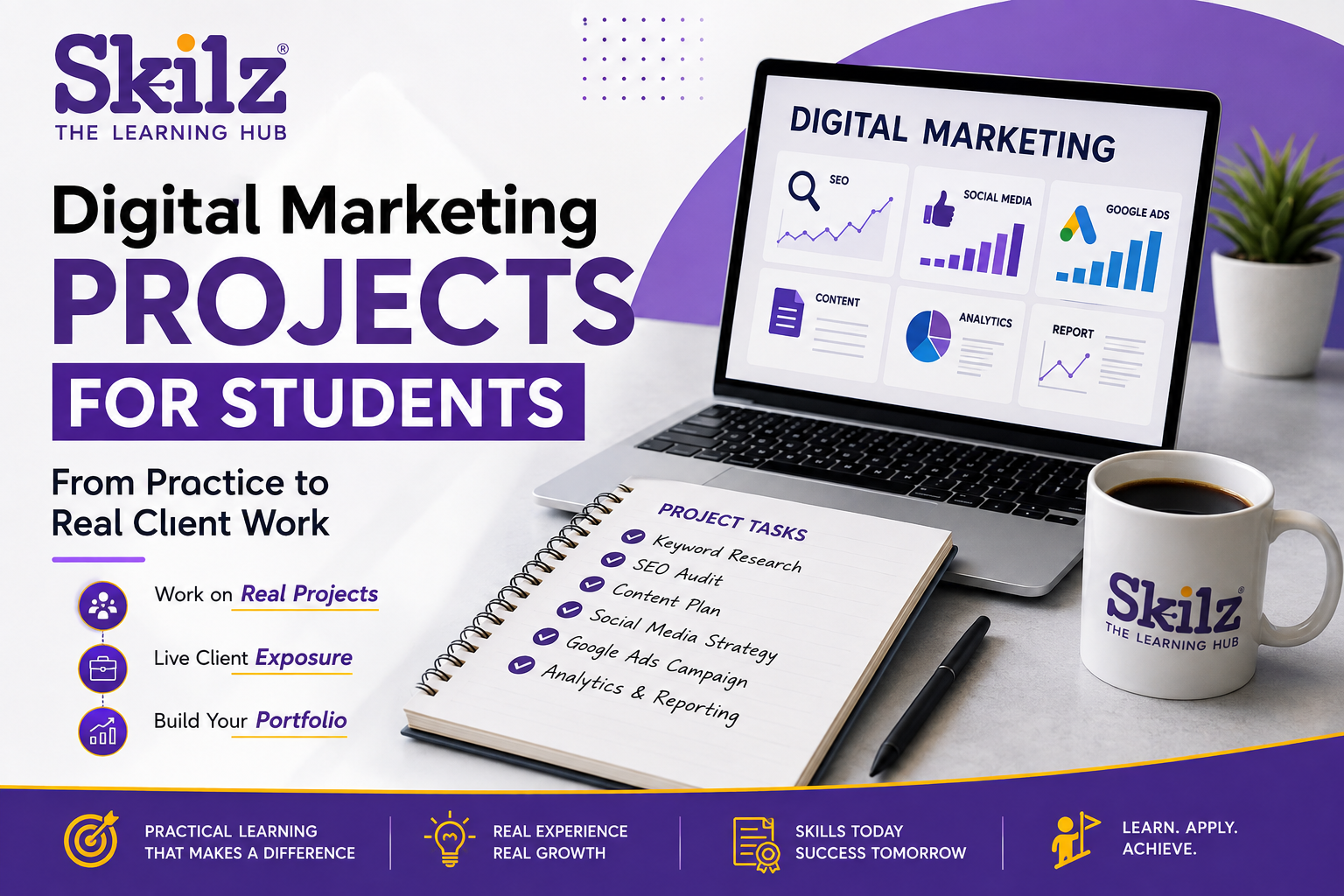
Digital Marketing Projects for Students: From Practice to Real Client Work
Digital Marketing Projects for Students: From Practice to Real Client Work
Learning digital marketing from a classroom or through online lessons is a good starting point. Students usually learn about SEO, social media, Google Ads, content writing and analytics one by one. But understanding a topic and actually using it are two different things.
The difference becomes clear when you work on a real project.
For students looking at a digital marketing course in Perinthalmanna, practical project experience is something worth checking before joining a course. You can learn the basics from videos and notes, but working on an actual website or campaign gives you a completely different kind of learning experience.
Why Practical Projects Make a Difference
Take SEO as an example.
A student may know what a title tag, meta description or keyword is. But the first time they have to check an actual website and decide what needs to be changed, things become more interesting.
You have to find the right keywords. You have to look at the existing content. You may notice that some pages have no proper headings, some images are missing alt text, or important pages aren't linked properly.
That's where the learning becomes practical.
A project can involve things such as:
Finding keywords for a particular business or industry
Checking and improving page titles and meta descriptions
Working on headings, images and internal links
Preparing social media content for a real audience
Planning a Google Ads campaign
Writing blogs with search intent in mind
Checking website and campaign data
Preparing a simple performance report
When students work through these tasks together, they start understanding how different areas of digital marketing connect with each other.
Projects Students Can Work On
You don't need a huge company or a massive campaign to get useful experience. A small project, if done properly, can teach you quite a lot.
1. Conducting an SEO Audit
Choose a real website and examine it from an SEO point of view.
Start with keyword research and then check the page titles, meta descriptions, headings, URLs, images, internal links and content. You can also look for missing content or basic technical issues.
Doing this on a live website is very different from simply reading about SEO. You begin to understand why certain changes are recommended and how they can improve the overall page experience.
2. Creating a Social Media Plan for a Local Business
A local business can also become a useful project.
It could be a café, clothing shop, fitness centre, salon or another business in your area. Study the business first, understand its customers and then prepare a content plan.
Decide what type of posts would be useful, which platforms are suitable and how frequently the business should post.
You can also decide how you would measure the results.
The exercise becomes much more meaningful when you're not just creating posts for practice but creating them with a particular business goal in mind.
3. Planning a Google Ads Campaign
Google Ads is another area where practical work helps.
A student can choose a business and create a sample campaign by researching keywords, deciding on the target audience, writing ad copies and selecting a suitable landing page.
You can then look at metrics such as impressions, clicks, CTR and conversions to understand how the campaign would be evaluated.
Even a practice campaign can help students understand why campaigns are structured in a particular way.
The Real Learning Starts With Client Work
Practice projects give you room to make mistakes. Client work is a little different.
When you're working for a real business, there is usually a deadline, a budget and a specific expectation. Sometimes the client may not even know exactly what they need.
For example, a business owner might simply say:
"We need more enquiries from our website."
That doesn't immediately tell you whether the solution is SEO, Google Ads, social media or something else.
You first need to understand the situation.
Maybe the website isn't getting enough visitors. Maybe people are visiting but leaving without enquiring. Perhaps the landing page needs improvement. There could also be issues with the existing advertising campaign.
Looking at the bigger picture before suggesting a solution is an important part of becoming a digital marketer.
This is one of the main differences between studying digital marketing and actually working in the field.
Skills You Develop Through Real Projects
Projects don't only improve technical knowledge. They also teach students how to work.
Communication
You learn how to understand what someone actually wants, ask questions when the requirements aren't clear and explain your ideas without using unnecessary technical language.
Problem-solving
Not every campaign produces good results on the first attempt. Sometimes traffic is low. Sometimes ads get clicks but no enquiries.
You have to find out why and decide what should change.
Time Management
Working with deadlines teaches you to plan tasks properly. You learn to prioritise work instead of leaving everything until the last minute.
Reporting
Knowing how to present results is also important. Clients want to understand what was done and whether it produced any useful outcome.
Confidence
There is a big difference between saying, "I know SEO," and showing someone an SEO audit, keyword research document or website optimisation work that you actually completed.
Projects give you something concrete to show.
Turning Projects Into a Portfolio
One of the best things about practical projects is that they can become part of your portfolio.
For example, your portfolio could contain:
SEO audit reports
Keyword research
Website optimisation examples
Social media content calendars
Google Ads campaign plans
Blog writing samples
Analytics reports
Short case studies
You don't need twenty projects.
A few well-documented projects can be much more useful. Explain what the problem was, what you worked on, why you selected that approach and what happened afterwards.
That gives a potential employer a much clearer idea of your skills than a certificate alone.
Why an Agency-Style Learning Environment Can Help
Digital marketing becomes easier to understand when you see how different tasks are handled in a working environment.
In an agency, SEO, content, social media, advertising and analytics are rarely treated as completely separate things. They often work together for the same client and the same business goal.
That's the kind of practical exposure students can get through the digital marketing programme at SkilzHub.
The training covers areas such as SEO, social media marketing, Google Ads, content marketing, analytics and AI marketing. Along with classroom learning, the programme focuses on practical assignments, live projects and internship experience.
For a student, this kind of exposure can make the transition from learning to working much easier.
What Makes a Project Worth Adding to Your Portfolio?
A project doesn't become valuable simply because it was completed.
A good project should make four things clear:
What was the problem?
Explain what the website or business actually needed.
What was your approach?
Mention the strategy you selected and why you chose it.
What did you do?
Show the actual work: keyword research, content creation, campaign planning, optimisation or whatever the project involved.
What happened?
Include the results whenever they can be measured. If something didn't work, that's worth mentioning too. Being able to explain what you learned from a failed attempt is part of practical experience.
This simple structure can turn an ordinary project into a useful portfolio case study.
You Don't Have to Start With a Big Project
If you're new to digital marketing, don't wait until you feel completely ready.
Start with something manageable.
Audit a small website. Prepare a social media plan for a local business. Do keyword research for a particular industry. Build a sample Google Ads campaign. Look at analytics data and try to understand what it is telling you.
Then take what you learned from that project and use it in the next one.
Over time, these small projects add up. Before you realise it, you have a portfolio that demonstrates what you can actually do.
Final Thoughts
Digital marketing becomes much easier to understand when you start working with real situations instead of only reading about them.
So, if you're comparing options for a digital marketing course in Perinthalmanna, don't look only at the syllabus or certificate. Ask how much practical work students get to do, whether they work on live projects and whether they get opportunities to build a portfolio.
A certificate can show that you completed a course.
A portfolio can show what you learned to do with it.
For someone starting a career in digital marketing, that practical difference can be important.





Comments (0)
Please login to leave a comment.
No comments yet. Be the first to comment!