


 SkilzHub Certification
 Adobe Certification
 Google Certification
 Meta Certification
 Semrush Certification
 Hubspot Academy Certification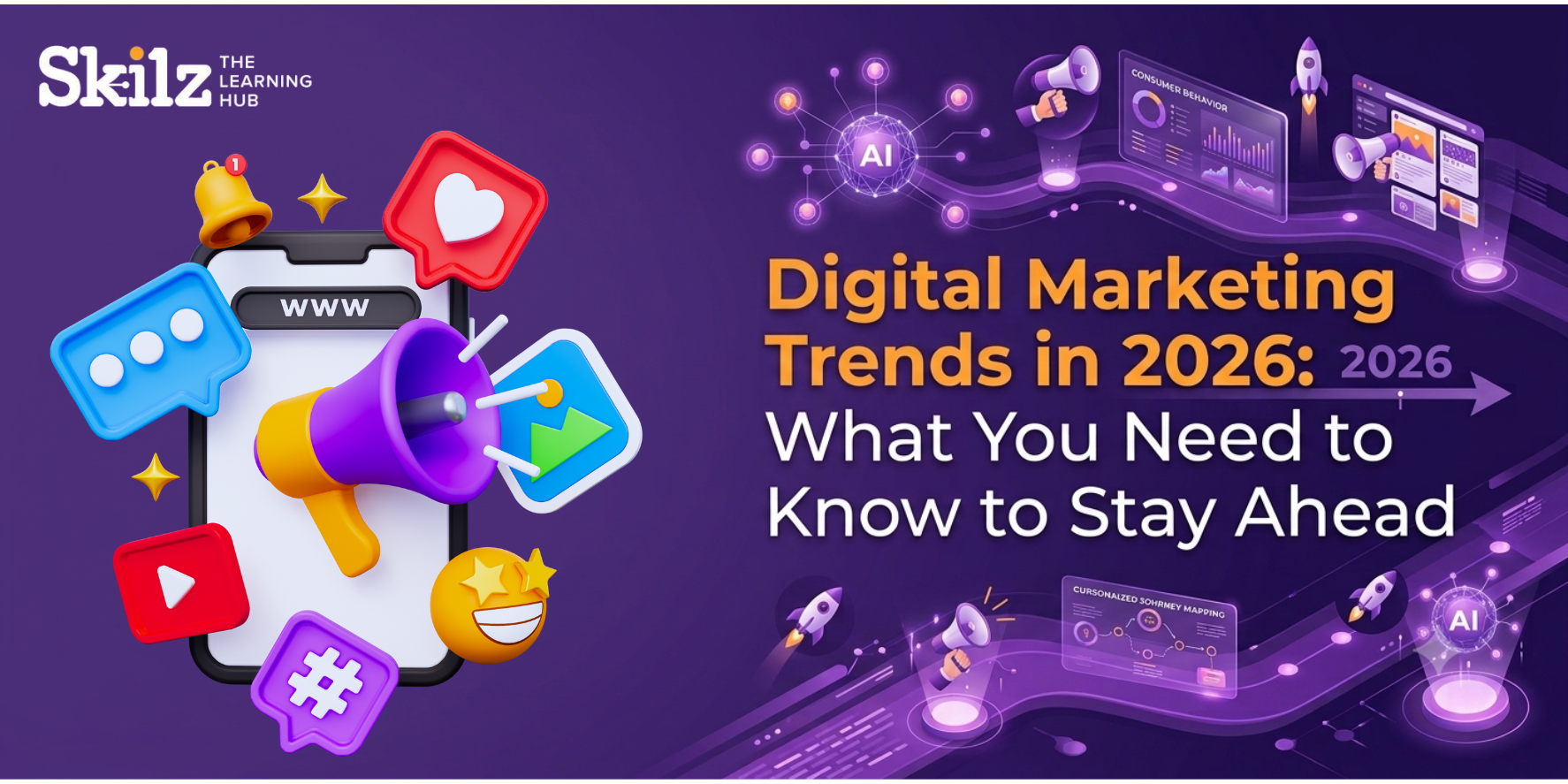
Digital Marketing Trends in 2026: What You Need to Know to Stay Ahead
Digital marketing is changing fast. 2026 is shaping up to be one of its most exciting years.AI has moved from being a test tool to a part of planning, creating, and optimizing campaigns. People are searching for things in ways. Some use traditional search engines while others relay on AI for answers. Consumers want authentic content, but AI-generated content is flooding every feed. For students and business owners, understanding these changes is crucial. It's the difference between marketing that works and marketing that doesn't. Here are the trends that are shaping marketing in 2026
1. AI Moves From Experimentation to Everyday Execution
In the past, AI in marketing meant testing tools. Now generative AI is good enough for work like writing emails, creating ads, and analyzing performance. Marketers are expected to direct AI systems, review outputs, and make decisions. The people who know how to work with AI are pulling ahead. What this means for you: If you're learning marketing, understanding how to work with AI tools is now a core skill.
2. Search Is Splitting: SEO Meets AI Visibility (GEO)
People still use Google. More and more discovery happens through AI chat interfaces and AI-generated search summaries. Brands need to make sure they are cited by AI tools, not just ranked by search engines. This shift is pushing brands to focus on E-E-A-T signals. Authorship, credible sources, and well-structured content.What this means for you: SEO isn't dead. It's evolving. Marketers need to think about how content performs in both search results and AI-generated summaries.
3. Personalization Is the Baseline, Not a Bonus
Consumers expect brands to know them. Brands can’t market in broad strokes anymore because most consumers say they prefer brands that know them. AI allows you to scale by segmenting audiences, customizing content, and updating messaging in real time based on user behavior. This is obvious in every little thing: custom emails, product recommendations, website content that changes depending on your actions.
And the catch? Many brands are still offering superficial personalization. People can tell the difference. Executing personalization beyond simply adding a first name to an email is turning into a real competitive advantage. In 2026, brands that use first-party data and understand their customers are loyal.
4. Social Discovery Is Overtaking Search for Product Discovery
More people are discovering new brands by searching on social media, from creators, and online communities. They search only to confirm what they already found. It changes the funnel: social is where the customer journey begins. People have already seen it somewhere, probably in their feed or in a group they trust, by the time they search for it on Google.
For brands and marketers, that means investing in creators, community, and authentic social content is no longer optional it's where the first impression happens. Short videos, real customer reviews, and word-of-mouth style content are beating the fancy advertisements because they look more genuine to people who are fed up with anything that looks too fake.
5. Immersive Experiences (AR/VR) Are Going Mainstream
Augmented and virtual reality are going from being a joke to a marketing tool. Consumers are more comfortable trying on things virtually, seeing furniture in their homes, or interacting with brands. Most would shop more if there was AR. As technology improves, this trend has real room to grow, especially in retail, real estate, and fashion. It also helps brands reduce purchase hesitation because customers can see the product before buying.
For smaller businesses, it doesn't mean that we have to build an AR app. Even something like a filter, a 360-degree view, or a try-on feature on social media can do the trick. I want people to feel like they're shopping for real, not online.
6. Agentic AI and Marketing Automation Are Scaling Up
Beyond simple automation, "agentic AI" systems that can make multi-step decisions and run campaigns with little oversight from us is becoming a real part of marketing. This is helping teams finally solve the problem of limited resources and slow campaign launch times. Marketers are using AI to generate and test dozens of creative variations, predict campaign performance before launch, and adjust targeting in real time. Instead of waiting weeks to launch a campaign, teams using agentic workflows can go from creating assets to launching it in a fraction of the time.
At the same time, there's this feeling that everything is starting to sound the same, because AI-generated creative is becoming homogeneous. The winning strategy in 2026 isn't just faster AI, it's AI that still feels like yours. That means feeding them strong brand guidelines, original data, and a point of view, rather than letting them default to generic, templated output.
7. Marketers Are Becoming Full-Stack, Product-Minded Professionals
One of the clearest changes this year: marketing roles are getting wider. Professionals should connect strategy, analytics, creativity, and technology, not specialize in one channel. I heard that some companies are creating positions that combine marketing and product-thinking, where marketers help create a product or feature, and then build the workflows to promote it. This is creating new job titles altogether.
What does this mean for you: Jobs in digital marketing are rewarding, but you need to be able to do more than just one thing. Now you know about SEO, ads, content, analytics, and AI tools. Professionals who study more than one subject are better prepared for the jobs that will be available in 2026.
Staying Ahead in a Fast-Changing Industry
Every trend in 2026 has one thing in common: despite how rapidly new tools are developed, the fundamentals of good marketing, such as knowing the audience, earning their trust, and crafting a concise story, will always be important. In the age that we currently live in, AI has the ability to create and analyze data, but without the necessary skilled human personnel to actually formulate a logical and effective strategy to promote business growth, the tasks will remain ineffective and unfulfilled. The most successful marketers will use AI to create their marketing strategies because the success of any strategy requires thorough, logical, and objective-based guidelines.
This is the primary motivation behind the creation of SkilzHub's Digital Marketing course. With the innovative, agency-taught training in Kottakkal and Perinthalmanna, you will learn the AI-centered, modern industry workflows of Social Media, SEO, PPC w/Digital Strategy, and more with the backing of real campaigns, industry expert mentorship, and job placement.
Are you prepared to develop a profession that aligns with the new evolution of Digital Marketing? Digital Marketing course at SkilzHub offers you the opportunity to begin with training that is relevant and immediate!
Comments (0)
Please login to leave a comment.
No comments yet. Be the first to comment!