


 SkilzHub Certification
 Adobe Certification
 Google Certification
 Meta Certification
 Semrush Certification
 Hubspot Academy Certification
Best Digital Marketing Institution in Perinthalmanna: What to Look for Before You Enroll
Best Digital Marketing Institution in Perinthalmanna: What to Look for Before You Enroll
A few years ago, "digital marketing" was a term most people in Perinthalmanna associated with Bangalore or Kochi something that happened in bigger cities at bigger companies. That's changed. Walk through town today, and you'll find clinics running Google ads, boutique stores managing Instagram pages with real strategy behind them, and coaching centers competing for search visibility. The shift has been quiet but steady, and it's brought with it a genuine demand for people who actually know how to do this work.
That demand is exactly why so many students and job-seekers are now searching for training in this field. But enrolling in the wrong place can cost you months of time and a good amount of money, with very little to show for it at the end. So before you sign up anywhere, it's worth slowing down and understanding what actually separates a strong program from a weak one.
The Problem With How Most People Choose
Most people choose a training program the way they choose most things based on what a friend mentioned, what showed up on Instagram, or which building looked the most professional. None of that tells you whether you'll actually learn anything. A polished Instagram page can be run by a marketing team that has nothing to do with the quality of the classroom experience. A friend's recommendation might be based on convenience, not outcomes. The building's interiors say nothing about who's teaching, what they're teaching, or whether the syllabus reflects what the industry actually looks like in 2026.
The only way to really know is to ask better questions before you commit.
Question One: Is the learning practical, or just slides?
This is the single biggest differentiator, and it's the one most people forget to check. Digital marketing is a hands-on discipline. You don't become good at SEO by memorizing definitions; you become good at it by actually optimizing a page, watching how it performs, and adjusting. The same goes for running an ad campaign, writing a caption that gets engagement, or reading a Google Analytics dashboard and knowing what it's telling you.
When you're evaluating a program, ask directly: will I be working on live campaigns, real client-style projects, and actual tools during the course, or will most of my time be spent watching slides and taking notes? If the answer is vague, that's a signal.
Question Two: Who Is Actually Teaching?
A lot of institutions advertise their curriculum heavily and say very little about their trainers. That's backwards. The curriculum can look identical across ten different places SEO, social media, Google Ads, analytics, and content because these are, broadly, the standard building blocks of the field. What varies enormously is who's teaching it and how current their own experience is.
Someone who is still actively running campaigns for real clients brings a very different classroom than someone who learned the material once and has been repeating the same slides for three years. Platforms change constantly, algorithms shift, ad formats get replaced, and new tools show up every few months. A trainer who isn't hands-on in the field right now is, almost by definition, teaching slightly outdated material, even with the best intentions.
Ask who your trainers are, what they currently work on outside the classroom, and whether you can speak to a past student about their experience.
Question Three: Does It Lead Somewhere?
A certificate on its own doesn't get anyone hired. What matters is whether the training actually builds something you can show a portfolio of real work, familiarity with tools employers expect you to know and ideally, some form of industry-recognized certification (Google, Meta, HubSpot, and Semrush certifications are the ones that tend to carry weight).
Beyond that, ask what happens after the course ends. Is there mock interview practice? Help build a portfolio. Any direct connection to agencies or businesses that are actually hiring? A program that ends the moment the syllabus is finished is leaving you to figure out the hardest part, actually getting hired entirely on your own.
Question Four: How Much Individual Attention Will You Actually Get?
Class size matters more than people expect. In a batch of sixty, it's easy to sit through an entire course without ever really getting your specific doubts addressed, without a trainer noticing that you're falling behind on a particular tool, or without getting real feedback on your own campaign work. In a smaller batch, that kind of attention is simply more possible. Ask about batch sizes before you enroll, and if you can, ask to sit in on an actual class before deciding.
What a Genuinely Complete Course Should Cover
Regardless of which institution you choose, the syllabus should give you real depth, not just surface familiarity across
Search Engine Optimization (SEO) - how websites and blogs actually rank on Google and why some pages outperform others that seem, on the surface, just as good
Social Media Marketing- building strategy and content for Instagram, Facebook, and LinkedIn that goes beyond just "posting regularly."
Paid Advertising - running and optimizing campaigns on Google and Meta and understanding how to read performance data rather than just launching and hoping
Content Writing - writing that's built to persuade and convert, not just fill space on a page
Analytics - the ability to look at a dashboard full of numbers and actually understand what decision it's pointing you toward
AI Tools in Marketing - using AI meaningfully to speed up research, drafting, and campaign work, without losing the judgment that makes marketing actually work
If a program is missing several of these, or only touches them briefly, it's worth asking why.
Why This Choice Matters More Than It Might Seem
Digital marketing is one of the rare fields where a strong body of real work can matter more than a formal degree. Employers and clients aren't hiring a certificate; they're hiring someone who can demonstrably bring in traffic, leads, and engagement. That means the quality of your training directly shapes how employable you are at the end of it, in a way that's more immediate and visible than in most other fields.
It's also worth remembering that Perinthalmanna's local market has its own character: small and medium businesses, education-sector clients, healthcare providers, and a growing number of first-generation entrepreneurs. A program with some grounding in that local context, alongside broader digital skills, tends to prepare students better for the kind of work they'll actually be doing early in their careers.
Learn Digital Marketing in Perinthalmanna With SkilzHub.
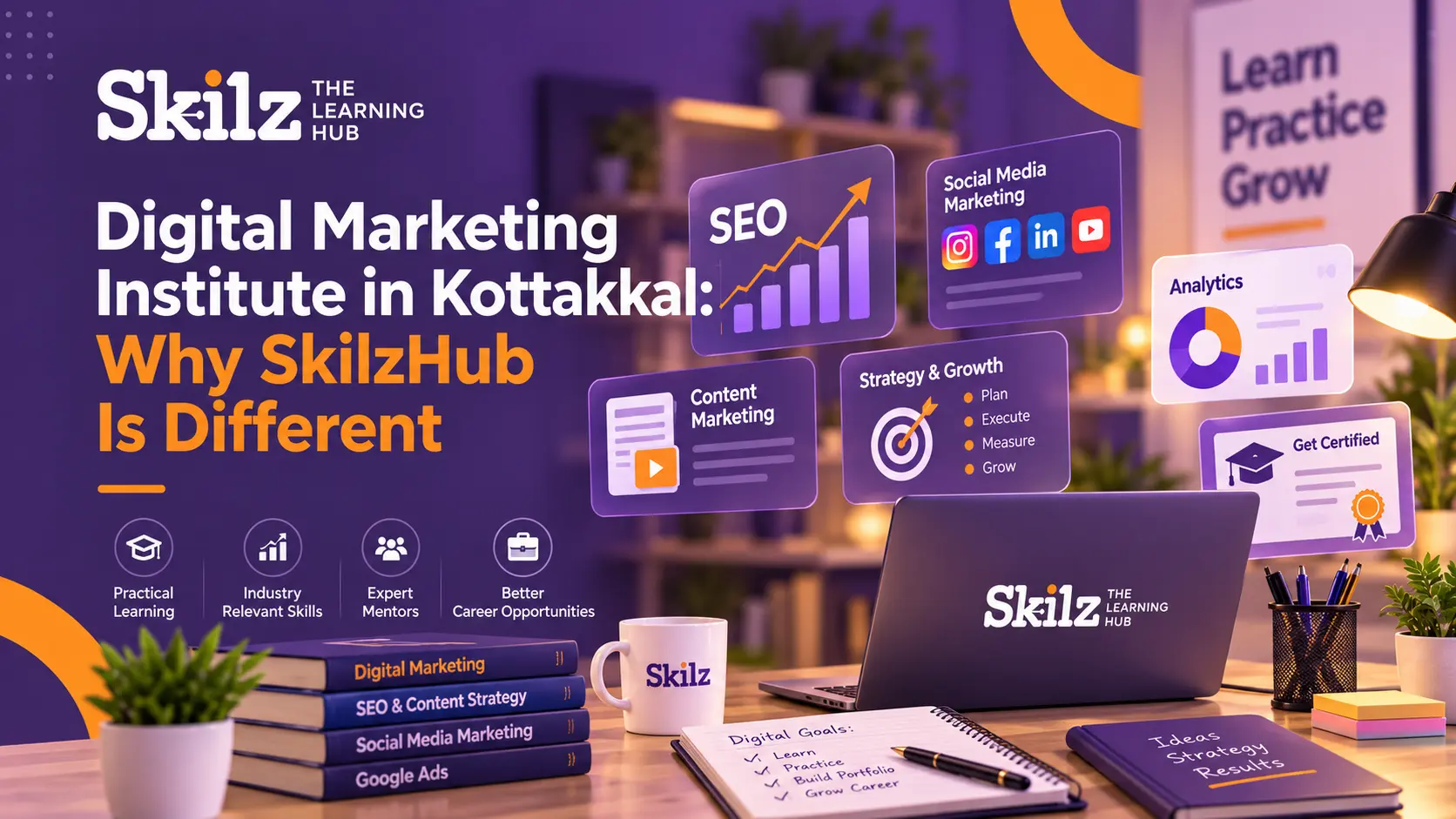
At SkilzHub, training is built around an agency model. Students work on live, real-world projects alongside trainers who are still actively working in the industry, not just repeating a fixed set of slides. The course covers SEO, social media, Google and Meta Ads, content writing, analytics, and AI tools, with a genuine focus on making students job-ready rather than just certificate-ready.
If you're weighing your options, the best next step isn't reading another comparison; it's visiting in person, sitting in on a class, and asking to see real work from real students. That, more than anything else, will tell you what you actually need to know.



Comments (0)
Please login to leave a comment.
No comments yet. Be the first to comment!