


 SkilzHub Certification
 Adobe Certification
 Google Certification
 Meta Certification
 Semrush Certification
 Hubspot Academy Certification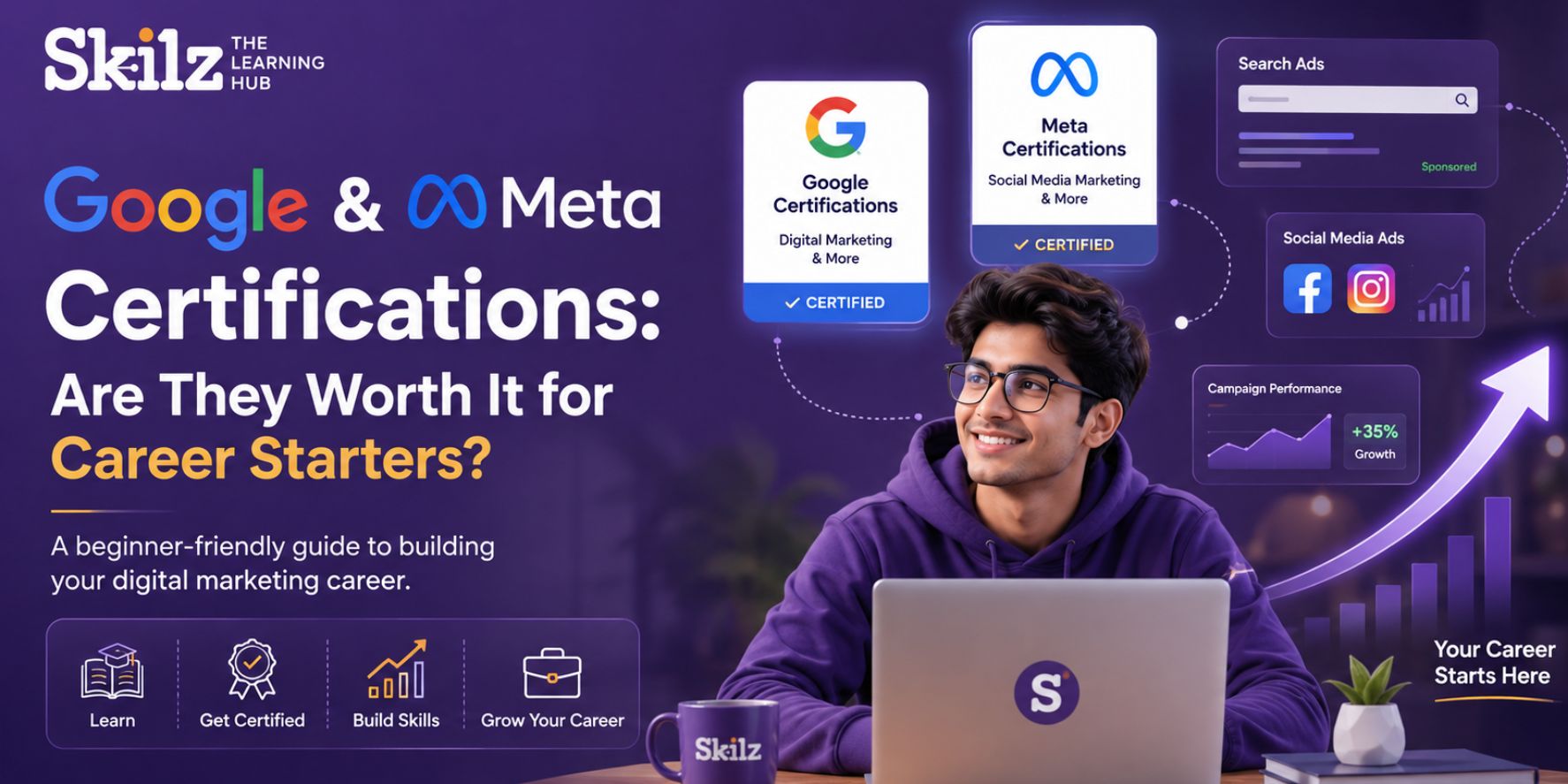
Google & Meta Certifications: Are They Worth It for Career Starters?
Starting a career in digital marketing can feel confusing. There are many skills to learn, tools to understand, and platforms to explore. For beginners, one of the most common questions is whether certifications from platforms such as Google and Meta actually help when applying for jobs.
The short answer is yes, but certifications work best when they are supported by practical skills and real project experience.
Google and Meta certifications can strengthen your profile, improve your understanding of advertising platforms, and show employers that you have taken the initiative to learn. However, they should be viewed as a starting point rather than a complete qualification for becoming a digital marketer.
What Are Google and Meta Certifications?
Google and Meta provide learning programs and certifications designed to help people understand how their advertising and marketing platforms work.
Google certifications commonly cover areas such as:
Google Ads
Search advertising
Display advertising
Video advertising
Shopping campaigns
Google Analytics
Campaign measurement
Meta learning programs focus mainly on marketing through platforms such as Facebook and Instagram. Topics can include:
Meta Ads Manager
Campaign planning
Audience targeting
Creative strategy
Media buying
Campaign measurement
Performance optimization
For someone entering digital marketing, these programs can provide a structured introduction to platforms that businesses use every day.
Why Are These Certifications Useful for Beginners?
When you have no professional digital marketing experience, it can be difficult to prove your knowledge to an employer.
Certifications give your resume something relevant to show.
For example, a candidate applying for a junior performance marketing role may appear more prepared if they have completed relevant Google Ads or Meta advertising certifications.
They indicate that the candidate understands at least the basic concepts behind paid advertising.
However, employers usually want to know something more important:
Can you actually use what you learned?
That is where practical training becomes important.
1. They Help You Understand Major Advertising Platforms
Google and Meta are among the most important advertising ecosystems in digital marketing.
Learning how these platforms work can introduce beginners to concepts such as:
Campaign objectives
Keyword targeting
Audience targeting
Ad groups and ad sets
Conversion tracking
Bidding strategies
Campaign budgets
Performance metrics
Remarketing
Understanding these concepts creates a strong foundation for anyone interested in performance marketing.
Instead of simply knowing that businesses advertise online, you begin to understand how campaigns are actually structured and measured.
2. Certifications Can Improve Your Resume
For a fresher, every relevant skill matters.
If two candidates have similar educational backgrounds but one has completed Google or Meta certifications, that candidate may have an additional advantage.
Certifications can be particularly useful when applying for roles such as:
Digital Marketing Executive
Performance Marketing Executive
PPC Executive
Google Ads Executive
Social Media Marketing Executive
Paid Media Executive
Digital Marketing Intern
They can also be added to your LinkedIn profile and portfolio.
However, avoid filling your resume with dozens of certificates without developing practical skills. A few relevant certifications supported by genuine knowledge are far more beneficial.
3. They Introduce You to Industry Terminology
Digital marketing has its own vocabulary.
Beginners quickly encounter terms such as:
CPC, CPM, CTR, CPA, ROAS, conversions, impressions, reach, attribution and remarketing.
These terms can initially appear complicated.
Certification courses introduce them in a structured environment and explain how they relate to campaign performance.
This can make it easier to participate in interviews, training sessions and workplace discussions.
4. They Can Help During Digital Marketing Interviews
Interviewers frequently ask freshers practical questions.
You may be asked:
What is CPC?
What is the difference between reach and impressions?
How would you select an audience for a Meta campaign?
What are negative keywords?
What is conversion tracking?
How would you measure whether a campaign is successful?
Completing Google and Meta learning programs can help you understand the concepts behind these questions.
But memorising definitions alone will not be enough.
Employers may also present situations such as:
“A campaign is generating clicks but no enquiries. What would you check?”
Answering these questions requires practical thinking, not simply certification knowledge.
5. They Show Initiative
For career starters, employers do not necessarily expect years of experience.
They often look for willingness to learn.
Completing recognised industry certifications shows that you have spent time learning beyond basic classroom material.
It demonstrates curiosity and professional interest.
That can be particularly valuable for students coming from educational backgrounds unrelated to marketing.
Are Google and Meta Certifications Enough to Get a Job?
No.
This is one of the biggest misunderstandings among digital marketing beginners.
A certificate proves that you completed an assessment or learning program. It does not automatically prove that you can manage a real advertising budget effectively.
Real campaigns involve situations that training modules cannot fully reproduce.
For example, marketers frequently need to deal with:
Campaigns generating expensive leads
Ads receiving clicks but no conversions
Poor landing page performance
Incorrect audience targeting
Tracking problems
Creative fatigue
Limited advertising budgets
Client expectations
Changing campaign performance
Learning how to respond to these situations requires practical experience.
Certification + Practical Experience Is the Better Combination
Consider two candidates.
Candidate A
Google Ads certification
Meta certification
No practical campaigns
No portfolio
Candidate B
Relevant certifications
Has created Google and Meta campaigns
Understands campaign reports
Has practised keyword research
Can explain optimization decisions
Has a portfolio containing practical projects
Candidate B will usually have much more to discuss during an interview.
That is why students should combine certification learning with hands-on digital marketing training.
At SkilzHub, students learning digital marketing are introduced not only to marketing concepts but also to practical areas such as SEO, performance marketing, Google Ads, social media marketing, content, WordPress and other industry-relevant skills. Combining structured training with certifications can help career starters develop a more complete understanding of how digital marketing works in real business situations.
Which Certification Should You Start With?
The answer depends on the career path you want to pursue.
If you are interested in Google advertising, start by learning Google Ads.
If you are interested in Facebook and Instagram advertising, focus on Meta advertising and Ads Manager.
If you want to become a performance marketer, learning both platforms can be particularly useful.
If your interest is primarily SEO or content marketing, these certifications are still helpful, but they should not become your main learning priority.
Your learning path should always match the type of digital marketing career you want.
Build Projects While You Learn
One of the best things beginners can do is convert their learning into small projects.
For example, you could create a sample marketing plan for a local business and explain:
The target audience
Campaign objective
Advertising platform
Proposed budget
Keyword strategy
Ad copy
Landing page idea
Expected KPIs
Optimization approach
Even if it is only a practice project, it demonstrates how you think.
You can include such projects in a portfolio and discuss them during interviews.
Do Employers Really Care About Certifications?
Some employers value certifications more than others.
A certification alone is unlikely to secure a job, but it can help your profile, particularly when you are starting with little or no experience.
Employers are ultimately interested in whether you understand marketing and can contribute to business results.
That means they may look at several factors together:
Knowledge + certifications + practical skills + communication + portfolio + willingness to learn
The certificate is therefore one part of your overall profile.
What Should Career Starters Focus on Beyond Certifications?
If you want to build a strong digital marketing career, do not stop after completing online certificates.
Develop skills in areas such as:
SEO
Google Ads
Meta Ads
Social media marketing
Content marketing
Keyword research
Google Analytics
Conversion tracking
Landing page optimization
WordPress
Basic design and creative understanding
Marketing reporting
You should also learn how these skills connect.
A strong digital marketer does not simply know how to press the “Publish” button on an advertising platform. They understand the customer, business objective, campaign strategy and results behind it.
Final Verdict: Are Google & Meta Certifications Worth It?
Yes, especially for career starters.
Google and Meta certifications can help beginners understand important advertising platforms, strengthen their resumes and prepare for entry-level digital marketing interviews.
But their real value depends on what you do after completing them.
Do not collect certificates just to add logos to your resume.
Learn the concepts. Practise the platforms. Build projects. Analyse campaigns. Create a portfolio.
When certifications are combined with practical digital marketing skills, they become much more valuable and can help you take a stronger first step into the industry.

Comments (0)
Please login to leave a comment.
No comments yet. Be the first to comment!