



 SkilzHub Certification
 Adobe Certification
 Google Certification
 Meta Certification
 Semrush Certification
 Hubspot Academy Certification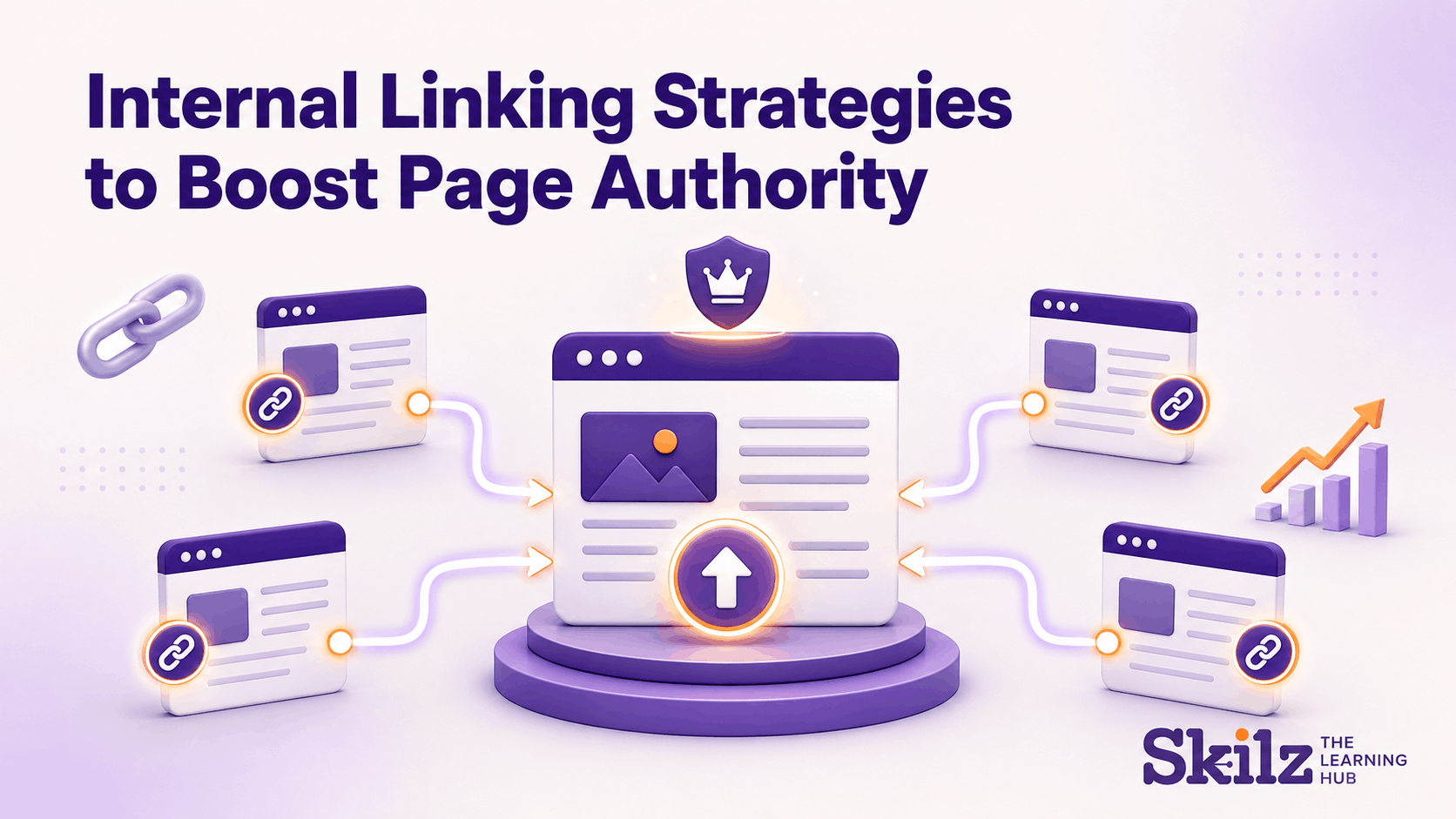
Internal Linking Strategies to Boost Page Authority
Internal linking is one of the most practical ways to improve a website’s SEO. It helps search engines recognize the relationship between pages, allows visitors to find relevant content and distributes authority throughout the website.
Many websites publish blogs and service pages regularly but fail to connect them properly. As a result, helpful pages remain difficult for users and search engines to find. A planned internal linking strategy can solve this problem and support better organic rankings.
What Is Internal Linking?
An internal link connects one page of a website to another page on the same domain.
For example, a blog about local SEO may include a link to the website’s SEO services page. Similarly, a service page can link to a related case study, FAQ page or supporting blog.
Internal links are different from external links, which direct visitors to another website. While external links can provide supporting information, internal links help strengthen the structure and authority of your own website.
How Internal Links Improve Page Authority
Every page earns a certain level of authority through backlinks, content quality, user engagement and other SEO signals. Internal links help pass some of that authority to other relevant pages.
For example, if a popular blog attracts backlinks and organic traffic, linking from that blog to an important service page can help search engines recognise the service page’s value. This does not guarantee higher rankings, but it gives the page stronger internal support.
Internal linking also helps search engines:
Identify newly published pages
Understand the hierarchy of the website
Identify the most important pages
Recognise relationships between topics
Crawl the website more efficiently
Understand the context of linked pages
A page with no internal links pointing to it is often called an orphan page. Search engines may find it difficult to learn or understand the importance of such a page.
1. Identify Your Most Important Pages
Start by identifying the pages that contribute directly to business goals. These may include:
Main service pages
Product or category pages
Location-based landing pages
Course pages
Lead-generation pages
High-value informational guides
These pages should receive more relevant internal links than less important pages.
For example, a digital marketing institute may treat its “Digital Marketing Course in Malappuram” page as a priority. Blogs about SEO careers, performance marketing, Google Ads and freelancing can naturally link to this course page.
The objective is to create several relevant paths leading users and search engines towards the priority page.
2. Build Topic Clusters
A topic cluster consists of one main page supported by several related pages.
The main page is usually a detailed service page, category page or complete guide. Supporting content addresses specific questions connected to the main topic.
For example:
Main page: SEO Services
Supporting blogs:
What Is Local SEO?
How to Conduct Keyword Research
Common Technical SEO Problems
How Internal Linking Supports SEO
How Long Does SEO Take?
Each supporting blog should link to the main SEO services page. Where relevant, the blogs can also link to one another.
This structure helps search engines understand that the website has meaningful coverage of the topic.
3. Use Descriptive Anchor Text
Anchor text is the clickable wording used for a link. It should clearly indicate what users can expect after clicking.
Instead of writing:
“Click here to learn more.”
Use:
“Learn more about our local SEO services.”
Descriptive anchor text gives users and search engines more context. However, avoid using the exact same keyword every time you link to a page. Use natural variations based on the sentence.
For an SEO service page, suitable anchor-text variations may include:
SEO services
Professional SEO methods
Improve your website’s organic visibility
Search engine optimisation support
Our SEO strategy
The anchor text should fit naturally within the content rather than appearing forced or repetitive.
4. Link From High-Authority Pages
Some pages on a website may already attract strong traffic, backlinks or engagement. These pages can be used to support other important pages.
Review your best-performing blogs and landing pages. Identify suitable places where you can add internal links to relevant pages that need more visibility.
Do not add links only because a page has authority. The linked pages must be contextually related. A link from an unrelated article may provide little value and can confuse visitors.
5. Add Links Within the Main Content
Links placed naturally within the main body of a page are often more useful than links hidden in the footer.
Contextual internal links appear within relevant paragraphs and help readers continue exploring a subject. For example, a blog discussing website visibility can link naturally to a detailed guide about technical SEO.
Navigation menus, sidebars, breadcrumbs and footers are still important. But, contextual links explain the relationship between two pages more clearly.
6. Link to Deeper Pages
Many websites send most of their internal links to the homepage. The homepage is important, but deeper pages also need support.
Blogs should link directly to the most relevant service, product or location page rather than linking only to the homepage. This creates a shorter path for users and helps search engines discover pages located deeper within the website.
A blog about lift maintenance in Dubai, for example, should link directly to the lift maintenance service page instead of directing readers to a general homepage.
7. Update Older Content With New Links
Internal linking should not be limited to newly published content.
Whenever you publish a new page, review relevant older articles and add links to the new content. Older pages may already receive traffic or have established authority, making them useful sources of internal links.
You should also review older links to identify:
Broken links
Links pointing to redirected pages
Outdated anchor text
Links to deleted pages
Missed opportunities to support important content
This makes internal-link maintenance an ongoing part of content optimisation.
8. Avoid Adding Too Many Links
Internal links should improve the reader’s experience. A page filled with unnecessary links can become distracting and may reduce the value of each link.
There is no universal number of internal links that works for every page. The right number depends on the content length, website structure and relevance of the available pages.
Add a link when it helps the reader understand a term, explore a related subject or reach a useful service. Avoid linking the same page repeatedly within a short section unless there is a clear reason.
9. Fix Orphan Pages and Broken Links
An internal-link audit can reveal pages that have few or no links pointing to them.
If an orphan page is useful, add links from relevant pages. If it is outdated, consider updating, redirecting or removing it based on its purpose and performance.
Broken links should also be corrected quickly. They create a poor user experience and waste crawl activity. Tools such as Google Search Console, Screaming Frog, Ahrefs and Semrush can help identify broken links and weakly connected pages.
10. Monitor the Results
After improving internal links, monitor how the affected pages perform.
Important metrics include:
Organic impressions
Keyword positions
Organic traffic
Crawl frequency
Click-through rate
User engagement
Conversions
SEO improvements may take time to appear. Internal linking works best when combined with useful content, strong on-page optimisation, a technically healthy website and relevant external backlinks.
Internal linking is more than adding random links between website pages. It requires understanding which pages are most important, how different topics are connected and what information visitors may need next.
Start with priority pages, build relevant topic clusters and link to them from strong supporting content. Use descriptive anchor text, update older articles and regularly check for orphan pages and broken links.
A well-planned internal linking structure helps page authority flow more effectively across the website. It also makes the website easier to manage, easier to crawl and more useful to visitors ; creating a stronger foundation for long-term SEO growth.



Comments (0)
Please login to leave a comment.
No comments yet. Be the first to comment!