


 SkilzHub Certification
 Adobe Certification
 Google Certification
 Meta Certification
 Semrush Certification
 Hubspot Academy Certification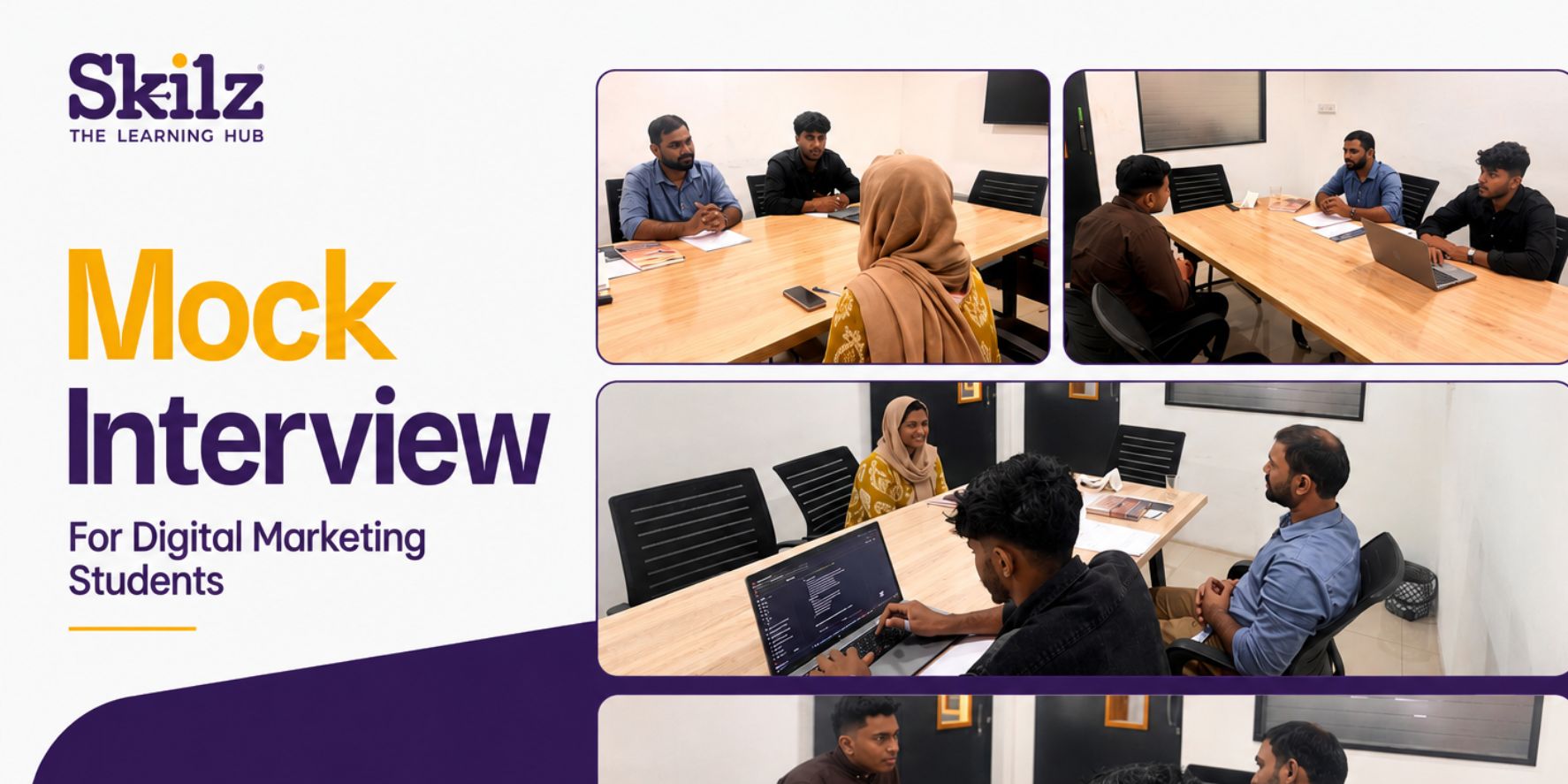
SkilzHub Mock Interview Session at D5N Digital Solutions: Preparing Students for Real-World Interviews
Finishing a digital marketing course and being ready for a job are two different things. A student can know how to set up a Google Ads campaign, read a Search Console report and write a decent meta description, and still go blank when an interviewer looks up from the resume and says, "So, tell me about yourself."
That gap is what the SkilzHub Mock Interview Session is meant to close.
Students from SkilzHub Kottakkal and SkilzHub Perinthalmanna are attending a full practice recruitment process at D5N Digital Solutions, Kottakkal, the parent company of SkilzHub. It is not a casual question-and-answer round. Students move through registration, orientation, an HR interview, a technical interview, a combined evaluation, and finally a one-to-one feedback discussion.
By the time they walk out, every student should be able to answer three things about themselves honestly: where do I stand right now, what is weak, and what do I work on before the next interview.
Why a practice interview is worth the effort
Most students who complete their training have the subject knowledge. What they don't have is the experience of being assessed by a stranger for twenty minutes.
An interview measures much more than what was studied. The panel is watching how you speak, whether you listen fully before answering, what you do when you don't know something, and whether you come across as someone the team can work with every day. None of that gets tested in a classroom.
For a student attending their first interview, even the easy questions become difficult. "Why should we hire you?" sounds simple until you have to say it out loud to a person taking notes.
A mock interview lets students face all of this in a place where a mistake costs nothing. They see how a professional interview actually runs, what HR looks for, what kind of technical questions come up, how much confidence and body language matter, and where their own preparation falls short. It is the difference between reading about interviews and sitting in one.
How the session is organised
The programme follows the same order most companies use:
Registration → Orientation → HR Interview → Technical Interview → Evaluation → One-to-One Feedback → Career Action Plan
Each stage adds something to the overall picture of how ready the student is for employment.
Registration and attendance
The day starts when students from the Kottakkal and Perinthalmanna branches reach D5N Digital Solutions.
Before any interview begins, the organising team completes registration. Students provide their name, branch, course or batch details, and contact information; confirm attendance and sign the register; and, beforehand, provide any career details the panel needs.
The paperwork is not just a formality. It gives the SkilzHub team a record of who attended, how each student performed and what was recommended, which matters later when the same student comes back for placement support.
Orientation
Students are not sent straight into the interview rooms. A short orientation happens first so that nobody is confused about what is coming.
The team explains why the session is being conducted, how the two interview rounds will run, what each panel will look at, how the evaluation sheet works and how feedback will be shared afterwards.
The idea is to remove confusion without removing the pressure. Students should still feel the nerves of a real interview, because that is the point. What they should not feel is lost.
The orientation also makes one thing clear early on: this is not a scoring exercise. Nobody is being ranked against a classmate. The marks exist only to show each student where they are and what to fix.
Round 1: The HR interview
The first round is handled by the HR team or an assigned HR panel.
Deep technical knowledge is not the focus here. The panel wants to see whether the student can hold a professional conversation and whether they show the basic qualities any employer expects from a fresher.
What the HR panel looks at
Communication comes first: can the student introduce themselves clearly, answer without rambling, and listen properly before responding? Beyond that, the panel notes confidence, attitude, awareness of their own career direction, willingness to learn, comfort working in a team and general professional presentation.
Typical questions include:
Tell me about yourself.
Why did you choose digital marketing?
What are your strengths?
Which area do you want to improve?
Why should a company hire you?
Where do you see yourself a few years from now?
How do you handle pressure?
Are you comfortable working in a team?
How would you handle a disagreement with a colleague?
What are your career goals?
Nobody expects a memorised answer. Rehearsed replies are usually obvious anyway. The panel is watching how the student thinks and responds when the question is put to them directly.
Checking whether the student fits a workplace
The HR round also looks at something harder to measure: whether this person will settle into a company environment.
Good technical skills alone will not carry someone through a job. Employers want to know whether a new joiner can take feedback without getting defensive, pick up new processes, own their work, keep things professional with colleagues and adjust to how the organisation runs. Freshers rarely think about any of this before their first interview, which is exactly why it helps to raise it now.
At the end of the round, the HR panel writes its observations and scores into the Mock Interview Evaluation Sheet.
Round 2: The technical interview
Next, students move to the technical round, taken by professionals and department representatives who work in the field every day.
For digital marketing students, the discussion stays close to what they covered in training. Depending on the batch and specialisation, questions may touch on SEO, social media marketing, Google Ads, Meta Ads, content marketing, keyword research, website analysis, analytics, campaign planning, lead generation, overall strategy, and basic reporting.
The panel usually avoids pure textbook questions. Instead, students get situations to work through. How would you improve the online visibility of a small business? How would you plan a social media campaign for a new shop? A website's organic traffic has dropped over three months, so what do you check first?
What the technical panel is assessing
Subject knowledge: Does the student actually understand what was taught, or has it only been memorised?
Practical understanding: Can they connect a concept to a real business problem?
Problem-solving: Given a messy situation, can they work through it and suggest a sensible approach?
Clarity: Knowing the answer is one thing. Explaining it to someone else is another, and clients will always need the second one.
Application: Can they show how a tool or strategy gets used in practice, not just describe what it is?
Attitude to learning: When a student doesn't know something, what happens? Guessing confidently is a problem. Saying "I haven't worked on that yet, but here's how I'd find out" is not.
The panel records marks, observations and recommendations on the same evaluation sheet.
Bringing the two evaluations together
Once both rounds are done, the sheets go to the concerned SRO for review.This step matters because one round rarely tells the full story. A student might handle the technical questions well and struggle badly with communication. Another might speak confidently for fifteen minutes without much depth behind it. Both students need help, but not the same help.
Reading the HR and technical observations side by side gives a fairer picture. Those key points are then carried over to the SkilzHub Student Feedback and Evaluation Sheet, which becomes the base for the final discussion.
Round 3: One-to-one feedback
For most students, this is the part that changes something.Rather than another interview, the student sits with the SRO and goes through their own performance in detail. What went well in the HR round. Where the answers wandered. How the self-introduction sounded to someone hearing it for the first time. Which technical areas came across as strong and which ones clearly need more work. How they reacted when a question caught them off guard.Getting a number on a sheet tells a student very little. Hearing exactly what an interviewer noticed about them tells them a lot.
Turning the feedback into something usable
Feedback is only useful if the student knows what to do on Monday morning.So the discussion moves quickly from observation to action. Depending on what came up, suggestions might involve reworking the self-introduction, practising spoken English or professional communication, going back over specific technical topics, getting more hands-on campaign work, building out the portfolio, fixing the resume, preparing better answers for the standard questions, learning to talk about their own projects properly, working on body language, or simply reading about a company before walking into its office.The advice is tied to what that particular student did in that particular room, not general tips anyone could have found online.
Planning the next real interview
The session is meant to sit between classroom training and the first job.So the final discussion also looks forward. Which skills need attention immediately, which topics need revision, how often the student should keep practising, what kind of roles suit their current level, how to present their projects, and how to sound more comfortable talking to a recruiter.A student leaving with clarity on those points has a plan. A student leaving with only a score has a number.
The individual action plan
Before finishing, each student puts together an improvement plan with goals they can actually measure. That usually covers practising the self-introduction regularly, completing extra technical assignments, strengthening weak subject areas, working on communication, preparing a proper resume, updating portfolio projects, attending more practice interviews and preparing for role-specific questions.The student reads through the feedback and signs the sheet. Signing it seems like a small thing, but it makes the plan feel like a commitment rather than a suggestion, and it reminds the student that interview preparation continues long after the session ends.
Why hold it inside a working company
Running the session at D5N Digital Solutions gives students something a training room cannot.They walk into an office where work is happening. They talk to HR professionals and technical staff who interview candidates as part of their job. They notice how people speak to each other, how meetings run, how a workplace actually feels compared to a classroom. For students about to enter the digital marketing industry, that exposure is worth as much as the interview itself.
Confidence before it counts
A first job interview is intimidating for almost everyone.But a student who has already sat through an HR round, faced a technical panel and heard an honest assessment of their performance is walking into familiar territory. They know the format, they can guess the questions, and they know which of their own answers need work. That familiarity is usually what separates a nervous candidate from a composed one.
How SkilzHub approaches career readiness
At SkilzHub – The Learning Hub, training is not treated as finished when the last module is over. Practical work, technical depth, communication and interview preparation all decide whether a student converts their course into a job.
The Mock Interview Session for the Kottakkal and Perinthalmanna batches, held at D5N Digital Solutions, Kottakkal, is one more step in connecting what students learn with what employers expect. HR assessment, technical evaluation, personal mentoring and clear feedback together give students a picture of themselves that no exam result can provide.
Interviews are rarely won the night before. They are won through knowing your own skills, practising how you talk about them, listening to honest feedback and fixing things gradually.
The SkilzHub Mock Interview Session gives students a place to get it wrong, understand why, and correct it before it happens in front of a company that was actually hiring.
When a student walks out knowing where they stand, what is missing and what to do next, the session has done its job. That is the point at which course-complete starts turning into career-ready.

Comments (0)
Please login to leave a comment.
No comments yet. Be the first to comment!