


 SkilzHub Certification
 Adobe Certification
 Google Certification
 Meta Certification
 Semrush Certification
 Hubspot Academy Certification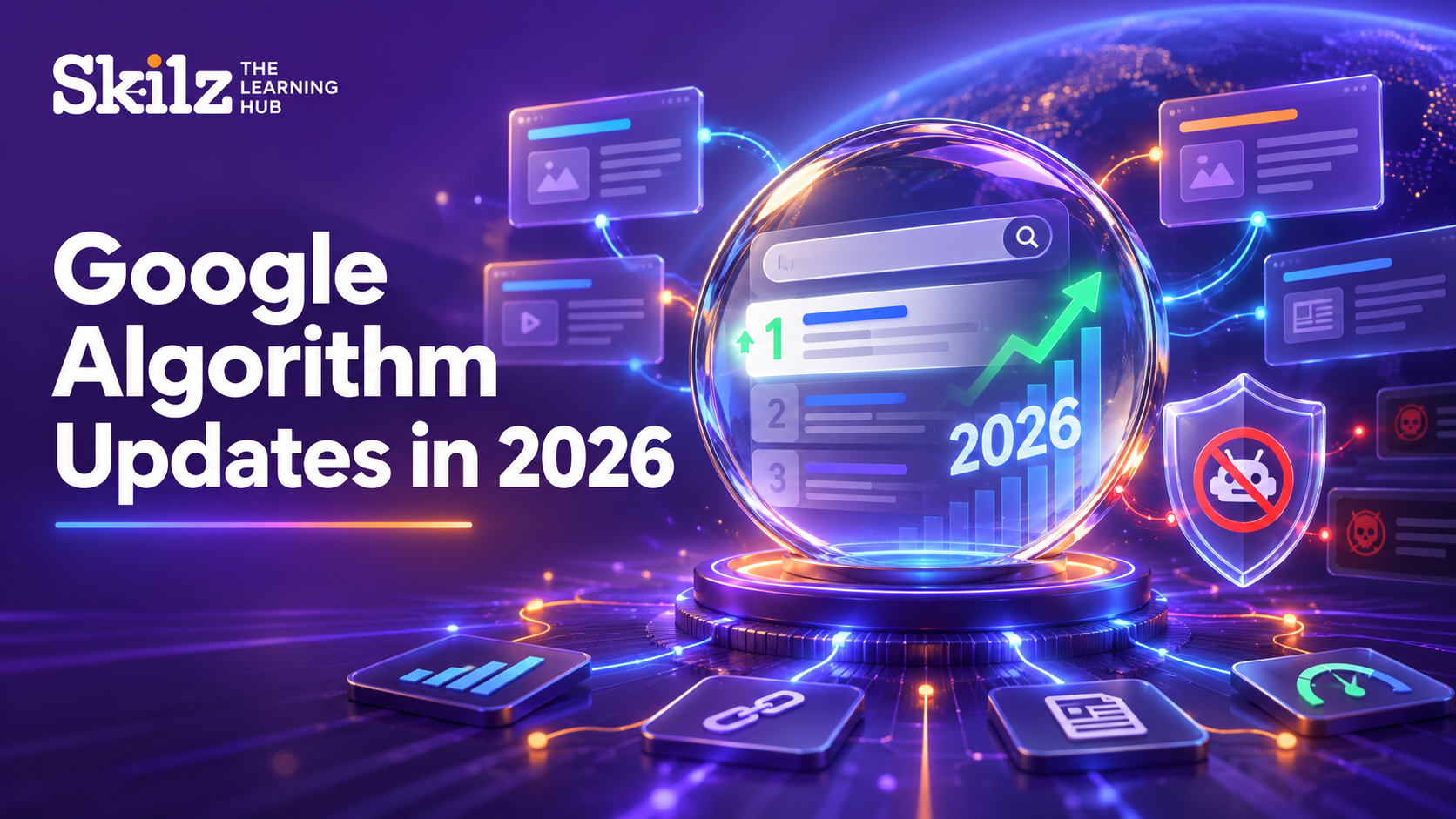
What Are the New Google Algorithm Updates in 2026
Google introduced several important search updates in 2026. These changes affected general rankings, spam detection, Google Discover and visibility in AI-powered search results.
For businesses and marketers, the concern is not simply whether a website has enough content. Google is looking more closely at whether each page is original, reliable and genuinely useful to the person searching.
May 2026 Core Update
Google released the May 2026 core update on May 21. The rollout was completed on June 2. It was the biggest general ranking update announced during the first half of the year.
A core update reviews how Google assesses pages across different industries. It does not target one particular SEO technique. Some websites may gain visibility while others lose positions because Google now considers competing pages more helpful.
If a page dropped after this update, adding more keywords may not solve the problem. The content may need better explanations, stronger subject knowledge or information that competing pages do not provide.
Business owners should examine whether each page answers the visitor’s actual question. A service page should explain what is offered, who it is suitable for and what the customer can expect. A blog should provide a useful answer instead of stretching a simple topic across several repetitive sections.
Google Released Three Spam Updates
Google rolled out spam updates in March, June and August 2026. Each update applied worldwide and covered all languages. These updates were designed to reduce content and practices that attempt to manipulate search results.
Websites may face problems when they publish:
Large numbers of weak pages
Copied or lightly rewritten articles
Similar location pages with only the place name changed
Hidden text or misleading links
Pages created only to target keywords
Paid backlinks intended to influence rankings
Automatically generated content without proper editing
Location-based SEO still works when every page serves a real purpose. A course page for Kottakkal, for example, should contain information relevant to students from that area. Repeating the same course description across several location pages will provide little value.
Google Discover Received a Core Update
Google released a separate Discover core update in February 2026. It initially applied to English-language users in the United States. Google said the update was intended to improve the quality and usefulness of content shown through Discover.
Google Discover does not work exactly like regular search. People usually find articles based on their interests rather than entering a keyword.
Publishers hoping to receive Discover traffic should pay attention to the article itself. The title should create interest without misleading the reader. Images need to be clear and original. The subject should feel timely or worth reading.
A dramatic headline might win a click, but it will not help if the article fails to deliver what was promised.
Back Button Hijacking Became a Spam Violation
Google added back button hijacking to its spam policies in April 2026.
Back button hijacking happens when a website prevents visitors from returning to the previous page normally. The user may be redirected to another page, pushed towards an advertisement or trapped on the website.
Google now treats this as a malicious practice that may lead to spam action. Website owners should check pop-ups, advertising scripts and lead-generation plugins. Visitors must be able to leave a page without being redirected against their choice.
AI Search Has Become Part of Regular SEO
AI Overviews and AI Mode have changed how people receive information from Google. A person may now see a generated explanation before opening any website.
This does not mean regular SEO has become outdated. Google has confirmed that its AI search features still depend on core ranking and quality systems. Websites do not need a separate collection of technical tricks to appear in these results. Pages have a better chance of being considered when they provide a clear answer and include information that is not copied from common sources. Good page structure also helps Google understand the subject.
Businesses should explain their services in plain language. Course providers can include genuine curriculum details, training methods, student work and trainer experience. Service businesses can publish real project examples, process details and answers based on customer enquiries.
Google has also clarified that an llms.txt file is not required for visibility in its AI search features. SEO fundamentals still matter more than unsupported AEO or GEO shortcuts.
Can AI-Written Content Rank on Google?
Google does not reject content only because an AI tool was used during its creation. What matters is the purpose and quality of the finished page.
Using AI to produce many pages without contributing anything useful can fall under scaled content abuse. The same concern applies whether the pages were written by software, people or a combination of both.
Before publishing an article, check whether it contains:
Accurate and current details
Knowledge specific to the subject
Examples that make the answer easier to understand
Natural language suited to the intended reader
A reason for someone to choose it over similar articles
A page assembled from information already repeated across hundreds of websites is unlikely to stand out. Original observations and real experience make the content more valuable.
Search Console Now Shows AI Search Performance
Google introduced dedicated generative AI performance reports in Search Console in June 2026. These reports help website owners understand how their pages appear in AI Overviews, AI Mode and generative features within Discover. SEO professionals can use this information to identify pages receiving impressions through AI search. They can also compare query patterns and examine how visibility changes over time.
Traffic alone may no longer provide the full picture. A page can gain brand exposure inside an AI-generated response even when the number of website visits remains limited.
How Should a Website Respond to a Ranking Drop?
Do not rewrite the entire website immediately after noticing a decline. First, confirm when the change began and whether it matches a recognized Google update.
Open Google Search Console and identify the pages that lost impressions or clicks. Check the queries connected with the decline. This will show whether the problem affects the whole website or only a particular topic.
Read the affected page as a customer would. Does it give a direct answer? Is any important detail missing? Does another website explain the subject more clearly?
Old content may also need attention. Prices, course details, statistics, software features and service information can become outdated. Updating the publication date without correcting the article will not make it fresh.
Technical checks are still necessary. Indexing problems, incorrect canonical tags, broken internal links and slow mobile pages can restrict performance. These checks should support the content review rather than replace it.
What Students Should Learn From These Updates
Modern SEO work involves more than finding keywords and placing them inside a page. A digital marketer must understand search intent, content quality, technical SEO, Search Console and changing search behavior.
Students looking for the best digital marketing institute in Kottakkal should check whether the training includes practical work with live websites. Reading about algorithm updates is useful, but analyzing traffic changes and correcting real pages develops stronger skills.
At Skilz Hub, students learn digital marketing through agency-based training, live projects and practical SEO activities. This helps them understand how an algorithm update can affect an actual business website and what should be checked before making changes.
What Matters for SEO in 2026?
Google’s 2026 updates show that weak shortcuts are becoming less dependable. Publishing more articles will not automatically improve rankings. Building links from random websites will not create lasting authority either.
A stronger SEO plan begins with accurate content, useful local information and a technically healthy website. Each page should have a clear reason to exist.
AI-powered search may continue to change how results appear. The basic expectation remains familiar. Give people information they can understand, trust and use.



Comments (0)
Please login to leave a comment.
No comments yet. Be the first to comment!