



 SkilzHub Certification
 Adobe Certification
 Google Certification
 Meta Certification
 Semrush Certification
 Hubspot Academy Certification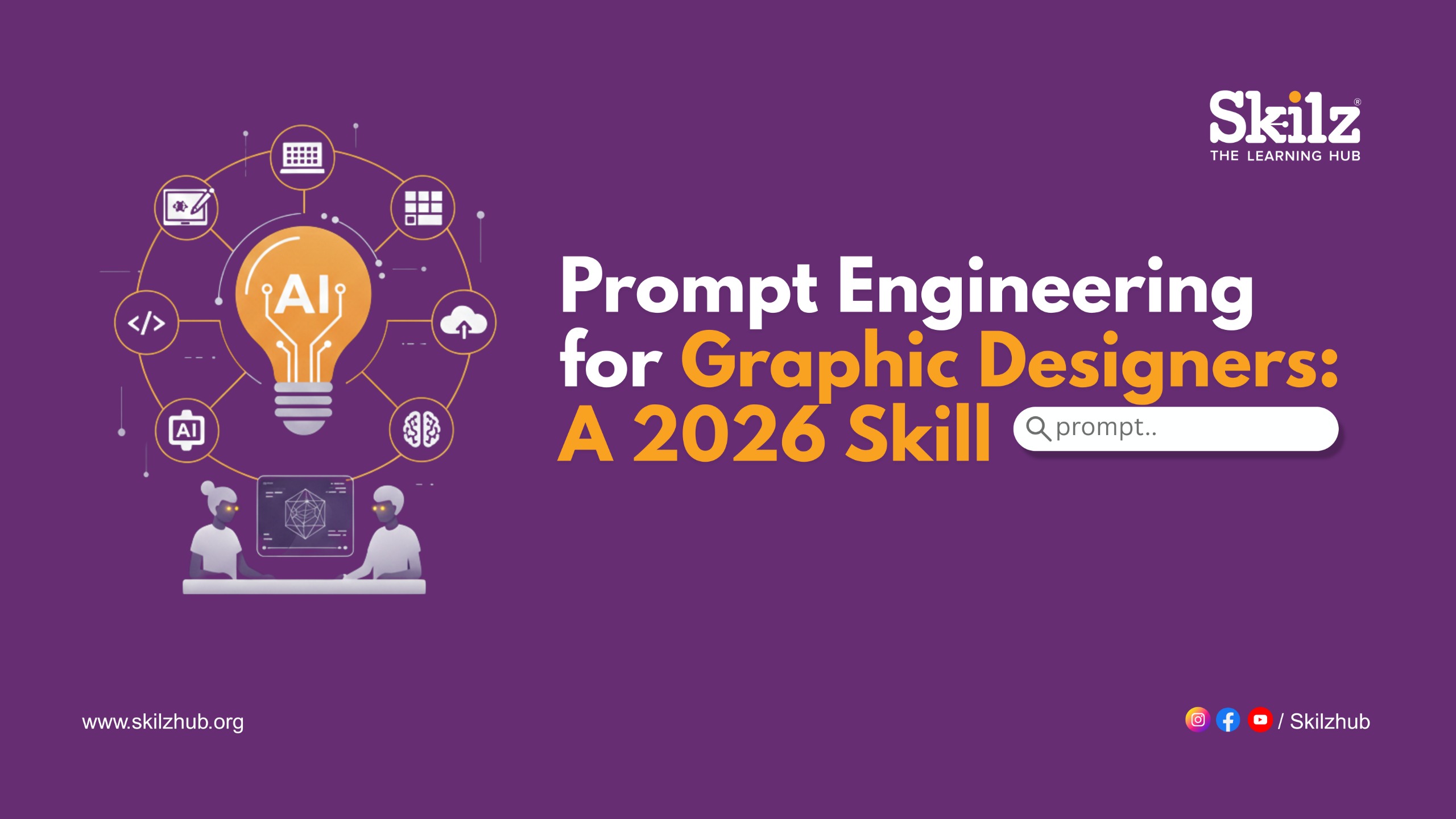
Prompt Engineering for Graphic Designers: A 2026 Skill
A 2026 Skill Technology has never left graphics design behind. Designers have evolved with hand-drawn layout to computer-based tool. The most significant change in the design industry in 2026 will be the emergence of AI-based design tools. However, to make good use of AI, a new skill is needed, which is prompt engineering.
For students and professionals learning from a leading graphic designing institute, this shift highlights how modern design education now blends creativity with intelligent technology.
To a graphic designer, prompt engineering is not an option anymore. It has turned out to be one of the essential abilities that characterize the effectiveness and imagination with which a designer can deal with AI.
What Is Prompt Engineering?
Prompt engineering can be defined as having the capability to provide explicit, elaborate, and imaginative directives to AI tools to produce ideal design outputs. These guidelines are known as prompts and direct the AI on how it should be styled, what mood, what color, what the layout should be like, and what purpose it has.
Simply put, briefing a design assistant is similar to prompt engineering. The more concise the brief, the better the output.
The Reason Prompt Engineering Is Important to Designers in 2026
Now AI technologies are able to create logos, drawings, social media posts, and design ideas within minutes. Nevertheless, in the absence of adequate prompts, the outcomes tend to appear generic or useless.
Graphic designers that are aware of timely engineering are able to:
● Develop design ideas more rapidly
● Maintain brand consistency
● Control creativity and style
● Increase productivity and efficiency
In 2026, customers will appreciate the designer that is capable of providing quality work within a short time-span, and timely engineering services will assist in making such a feasible.
Prompt Engineering and Its Benefits to Design Workflow
Brainstorming and Ideation That Is Faster
Prompts enable designers to come up with several design solutions immediately. This will assist in concept discussions, presentation to clients, and initial creative phases.
Better Creative Control
Designers can control AI outputs to be in line with the actual project specifications by indicating design components like color schemes, typeface, target customers, and brand voice.
Reduced Repetitive Work
With monotonous tasks such as background creation, mockups, or variations, AI can pre-analyze and execute backgrounds, mockups, or variations, leaving designers to make creative choices and optimize.
The Most Crucial Timely Engineering Skills to a Graphic Designer
Graphic designers ought to learn, to remain relevant in 2026—especially those enrolled in a professional Graphic Designing course that prepares them for AI-powered creative environments:
● The description of design styles
● How to formulate brand objectives and target audience in prompts
● How to improve prompts to give improved results
● The question of how to integrate AI-generated content with manual skills in design
● Assessing and enhancing AI results These skills will allow designers to leverage AI as a collaborative creative element instead of a competitor.
Artificial Intelligence and Human Innovation:
An Effective Climate Change AI can create designs, but it does not know feelings, cultures, and brand strategy as human beings do. The gap between human creativity and AI-friendly instructions is bridged by prompt engineering, which enables designers to integrate human creative ideas into artificial intelligence.
Designers who master such skill will be able to provide unique, meaningful designs which will appeal to audiences—an aspect that will still be appreciated by clients in 2026.
Conclusion
Timely designing is rapidly turning into a major talent of graphic designers. In 2026, the most successful designers will not be the ones who evade AI, but the ones who will know how to intelligently use it.
Through training in prompt engineering, graphic designers will be able to remain competitive, innovative, and demanded regardless of the changes in technology.




Comments (0)
Please login to leave a comment.
No comments yet. Be the first to comment!